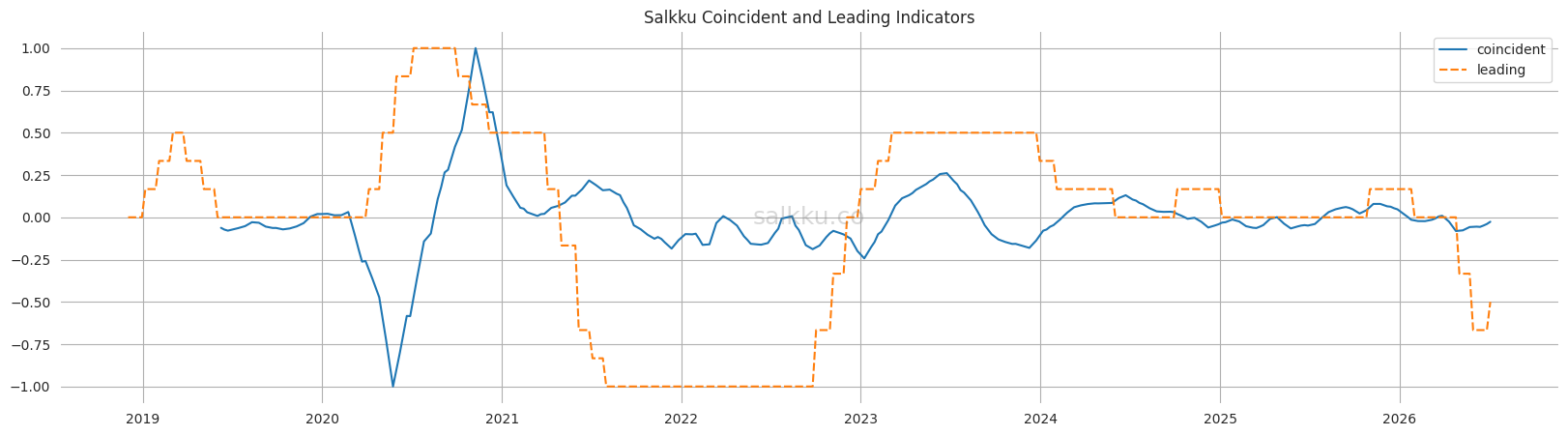
The Salkku Markets Outlook for Q2 2026 adopts a cautious and neutral stance for global stock markets over the next 12 months, with still both the Salkku Coincident Indicator and Salkku Leading Indicator being in the negative readings over Q2. Both readings are however improving and suggesting a positive market returns over longer time horizon.
Executive Summary
Salkku Markets maintains a cautiously neutral stance on global equities over the next 12 months. Both the Salkku Coincident and Leading Indicators remain in negative territory as of early July 2026, though they show clear improvement from Q1 levels. This suggests near-term challenges amid moderating economic momentum, geopolitical tensions (particularly in the Middle East), and elevated volatility in risk assets.
However, Salkku’s machine learning model points to a strong 91% probability of positive stock market returns over the 12-month horizon, supported by a shift toward robust, capex-driven growth—especially in AI-related sectors—offsetting earlier inflation concerns. Broader context from global indicators, such as the Conference Board’s U.S. Leading Economic Index (LEI) and PMI data, reinforces a resilient but uneven recovery picture, with services holding up better than manufacturing.
Investors should remain vigilant on short-term volatility, particularly in high-beta assets like technology stocks, cryptocurrencies, and commodities, while positioning for longer-term opportunities in quality growth and cyclical recovery plays. Overall, the outlook balances caution with measured optimism.
Salkku Coincident Indicator for Global Markets
The Salkku Coincident Indicator assesses the current health of the global economy, drawing primarily from the Composite Global Purchasing Managers’ Index (PMI). This index captures real-time business activity across manufacturing and services sectors.
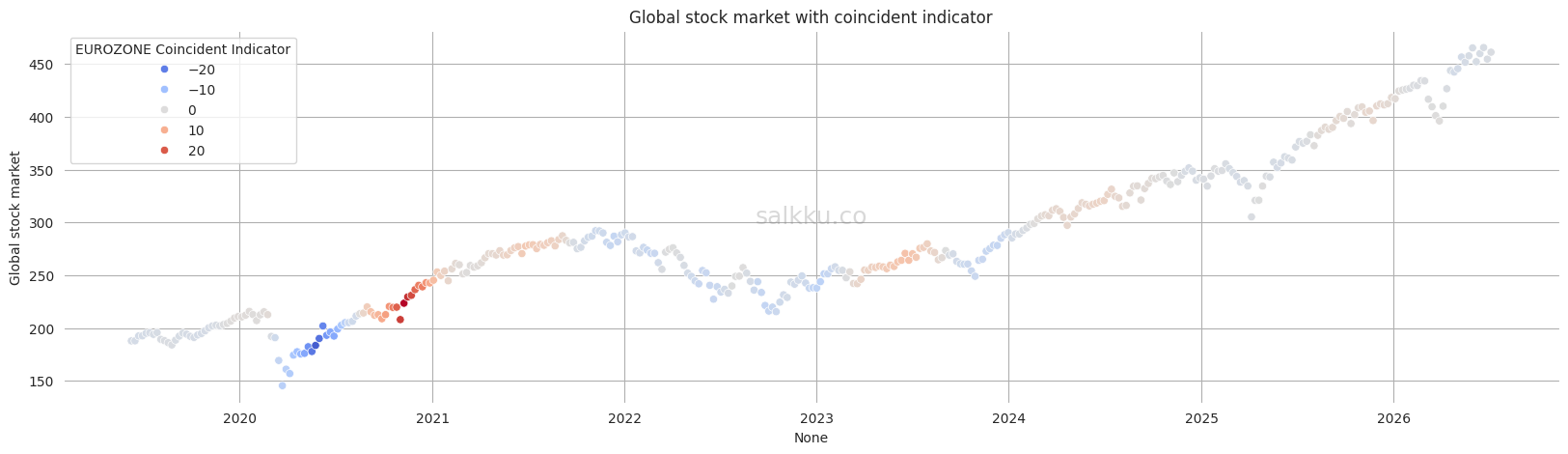
As of early July 2026, the indicator stands at -0.6, reflecting a slight improvement from Q1 2026 but still indicating sub-trend conditions. Recent PMI readings show manufacturing cooling (e.g., U.S. ISM PMI at 53.3 in June) while services provide relative support, consistent with broader global data amid energy price volatility and moderating demand.
Salkku Leading Indicator for Global Markets
The Salkku Leading Indicator aggregates forward-looking signals—including economic sentiment surveys, new manufacturing orders, yield spreads, and financial market metrics—to forecast global stock market performance over the next 12 months.
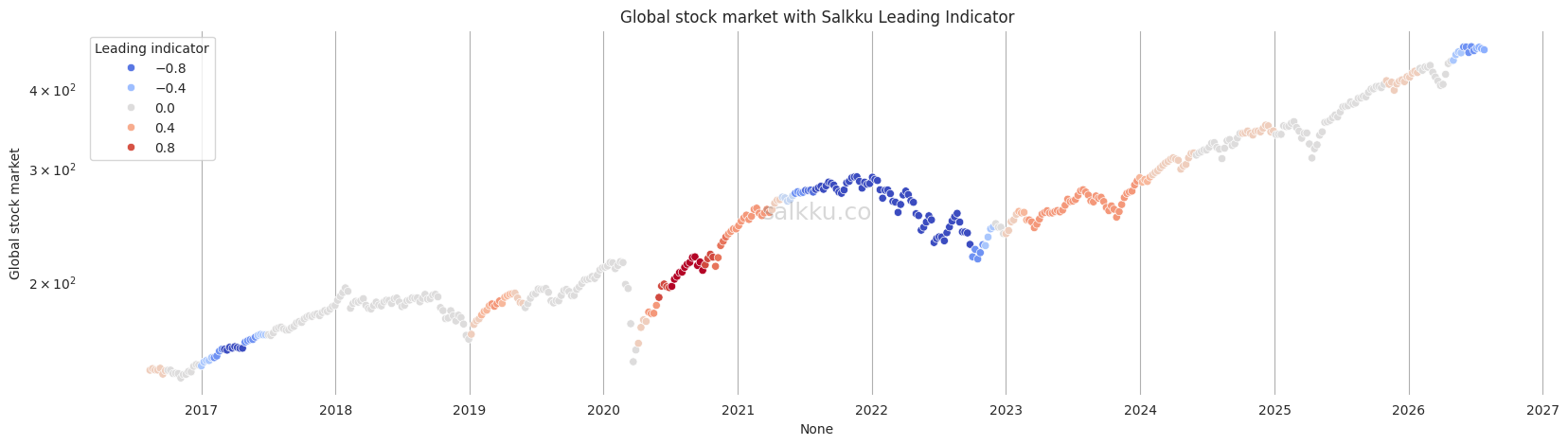
In July 2026, it registered -0.5, signaling that returns are likely to lag long-term averages in the near term. This aligns with external benchmarks like the Conference Board U.S. LEI, which has shown modest declines but stabilizing six- and twelve-month growth rates amid resilient business investment.
Model Prediction
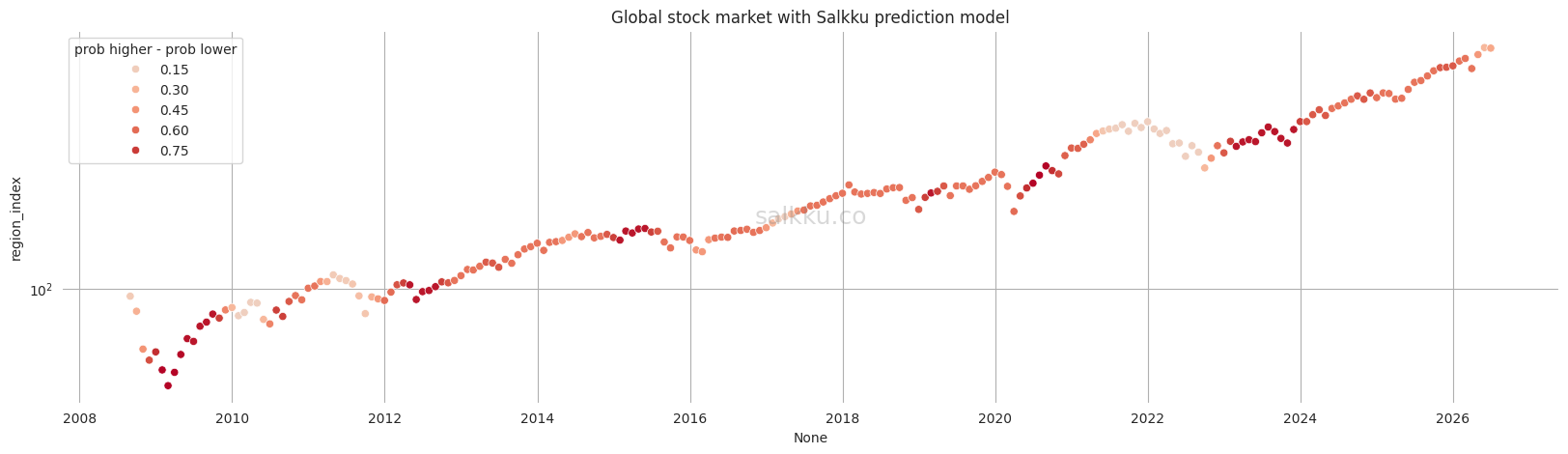
Salkku’s proprietary machine learning model forecasts positive stock market returns over the next 12 months with a very high 91% probability. The fragile, inflation-constrained growth outlook prevalent in Q1 has eased considerably. We are now transitioning into a more robust, capital-expenditure-driven expansion across a broad range of industries, particularly those benefiting from AI infrastructure and technological innovation. This shift provides a constructive backdrop for equities, even as cyclical headwinds persist.
Risk Asset Cycles
Risk assets have exhibited reliable cyclical patterns over recent decades, characterized by multi-year “supercycles” and shorter multi-month cycles (typically under one year). High-beta assets—such as technology stocks and cryptocurrencies—show the strongest sensitivity, with commodities displaying moderate exposure.

Current analysis indicates a pause in the most expansionary/speculative phase of the multi-year cycle (previously highlighted in yellow in related figures) and a shift toward contraction. The shorter-term cycle has similarly turned contractionary. With both cycles now aligned in contraction, heightened caution is warranted, especially for the riskiest segments prone to amplified volatility.
Figure 4 illustrates this transition, historically associated with negative performance for speculative assets.
Overall Recommendation
The medium- to long-term outlook remains positive, underpinned by improving indicators, easing inflation pressures, and strong secular tailwinds from AI-driven capex. That said, the short term calls for prudence: anticipate increased volatility and potential drawdowns in high-beta risk assets such as technology stocks, cryptocurrencies, and commodities.
Diversification, focus on quality earnings growth, and selective exposure to resilient sectors are advisable. Salkku will continue monitoring key indicators, including PMI trends, LEI components, and geopolitical developments, for timely updates.